Imagine. It’s a beautiful fall morning in North Carolina, and you let your dogs into your fenced backyard just as you do every day. A few minutes later, you hear frantic barking and head outside to investigate. You find your two dogs at the fence with a raccoon cornered nearby.
You quickly call your dogs away, and the raccoon escapes. You look both dogs over and don’t see any obvious bites, scratches, or other wounds. Still, you know that raccoons can carry rabies, and you begin to wonder: Could my dogs have been exposed?
Rabies concerns don’t always look the same. Other situations might include:
- Your dog comes running back from the yard with a dead raccoon.
- Your cat gets into a fight with an unknown animal.
- You wake up to find a bat in the bedroom.
- Your child is scratched or bitten by an unfamiliar animal.
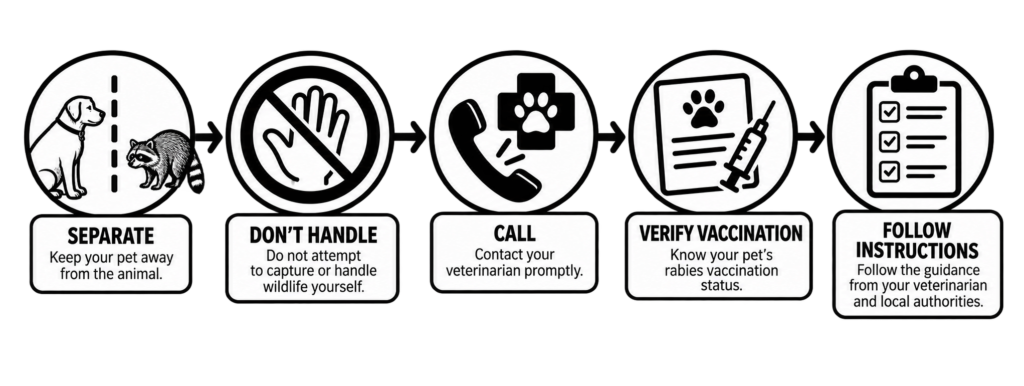
Situations like these can understandably bring a rush of concern and plenty of questions. Was there actually an exposure? Does my pet’s rabies vaccination status matter? What should I do about the wild animal? If your pet may have been exposed, contact your veterinarian promptly. During regular business hours, call your primary care veterinarian. If they are unavailable, an emergency or urgent-care veterinary facility can help guide you.

Veterinarians routinely help pet owners navigate possible rabies exposures. We can review what happened, check your pet’s rabies vaccination history, examine your pet when needed, and help determine what should happen next. Depending on the circumstances, your veterinarian may need to involve animal control and/or public health officials.
Importantly, simply being near a potentially rabid animal does not necessarily mean an exposure occurred. At the same time, the absence of an obvious wound may not provide enough information to rule one out. When there is uncertainty, let veterinary and public health professionals help assess the situation.
What Actually Counts as a Rabies Exposure?
Rabies is transmitted when infectious saliva or nervous tissue (such as any part of the brain or spinal cord) from a rabid animal enters the body. Depending on the circumstances, an exposure may include:
- A bite that breaks the skin
- Saliva or nervous tissue entering a scratch, abrasion, or other open wound
- Saliva or nervous tissue contacting the eyes, nose, or mouth
- Certain encounters with bats require special consideration because bites and scratches can be difficult to recognize
Rabies deserves to be taken seriously because once clinical illness develops, it is nearly always fatal. However, an encounter with an animal does not automatically mean a rabies exposure occurred, and an exposure does not mean someone will develop rabies. The key is recognizing when an exposure may have occurred and seeking guidance promptly.
When you speak with your veterinarian, be prepared to describe what happened. We will likely ask what type of animal your pet encountered, whether you witnessed direct contact, whether you see any bites, scratches, or other wounds, whether the other animal is still available, and whether your pet is currently vaccinated against rabies.
This is also a good reminder to keep your pet’s vaccination records somewhere you can easily access them. If an encounter occurs after hours, over a weekend, or during a holiday, having that documentation available can be especially helpful.
Your Pet Just Tangled With a Wild Animal: What Should You Do?
If your pet may have had contact with a potentially rabid animal, separate your pet from the animal without putting yourself at risk. Do not attempt to capture or handle wildlife yourself. Call your veterinarian and follow the guidance provided by veterinary, animal control, and public health professionals.
Animal control or your local health department can provide guidance about the animal involved. If the animal is found dead, do not dispose of it before speaking with the appropriate authorities. Depending on the circumstances, the animal may need to be tested for rabies, and whether it is available for testing can influence what happens next.
Why Your Pet’s Vaccination Status Matters So Much
 One of the first questions veterinarians will ask after a potential rabies exposure is, “Is your pet currently vaccinated against rabies?”
There is an important reason we ask. Rabies vaccination can significantly affect how a dog, cat, or ferret is managed after an exposure. In North Carolina, dogs, cats, and ferrets are required to receive a rabies vaccination by four months of age and remain current on their vaccinations throughout their life.
If an exposure occurs, your pet’s vaccination history will be considered along with the circumstances of the encounter and, when applicable, information about the animal involved. This is one of those situations where keeping your pet’s rabies vaccination current, and having the documentation to prove it, can make a meaningful difference.
Rabies Reminder:
✓ Keep your pet’s rabies vaccination current
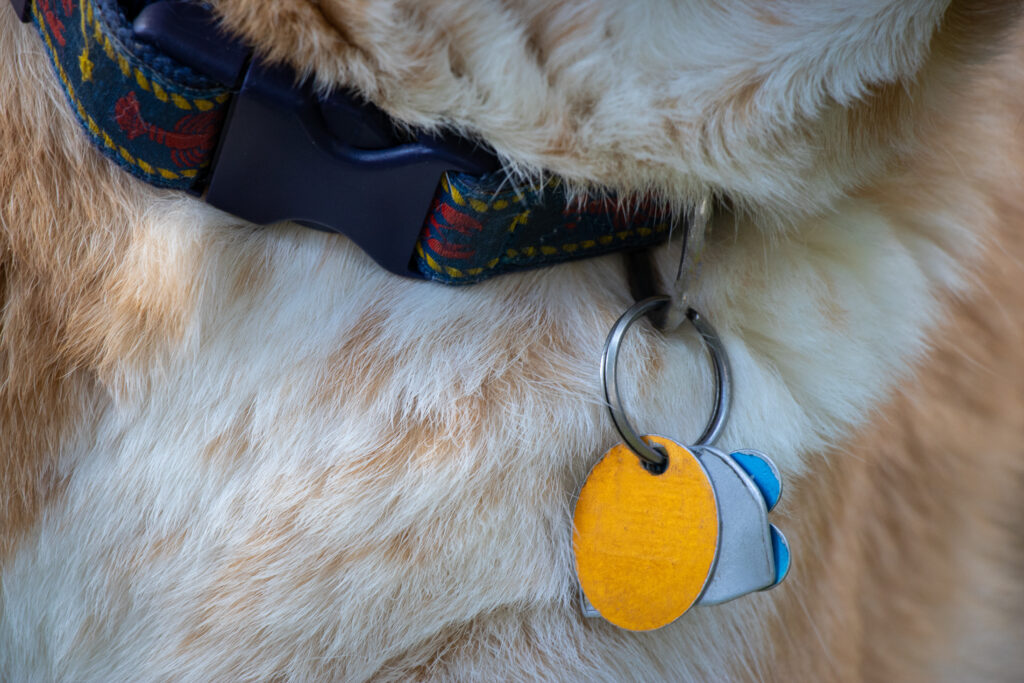
✓ Keep vaccination records easy to access (a rabies tag alone is not appropriate proof of vaccination!)
✓ Call your veterinarian promptly after a potential exposure
What Happens Next Depends on the Situation
There is no single response that applies to every possible rabies exposure. Management will differ depending on whether a pet is currently vaccinated, overdue for vaccination, or has never been vaccinated.
Other factors matter as well, including the species involved, the nature of the contact, whether the suspected animal is available for testing, and the test results when testing is appropriate. Veterinarians, animal control, and public health officials use this information together to determine how an individual situation should be managed.
In the best case scenario, your animal has been current on its rabies vaccination their entire life, and it will just need a booster shot (Phew!). If they are not current or have never been vaccinated for rabies, your veterinarian and public health official will need to determine if a combination of booster shots and quarantines (either at home or at your expense in an isolation ward) would be appropriate. In the worst case scenario, euthanasia of your pet may be determined to be the best option to protect the people and other animals in your life. No one wants this outcome, which is why your veterinarian prompts you every visit to stay current on rabies.
Who Do I Call?
Rabies prevention involves several professionals, and understanding their roles can make a stressful situation a little easier to navigate.
- Your veterinarian: Evaluates your pet, verifies vaccination history, provides appropriate veterinary care, and helps you navigate the animal-health side of a potential exposure.
- Animal control: May assist with locating, safely capturing, confining, or arranging testing of the animal involved.
- Local health department: Evaluates potential human rabies exposures, helps determine whether human post-exposure prophylaxis (PEP) is indicated, and has important responsibilities related to rabies investigations and animal confinement.
- Human healthcare provider: Evaluates and treats wounds and provides medical care, including rabies PEP when indicated.
What If YOU Were Bitten, Scratched, or Otherwise Exposed?
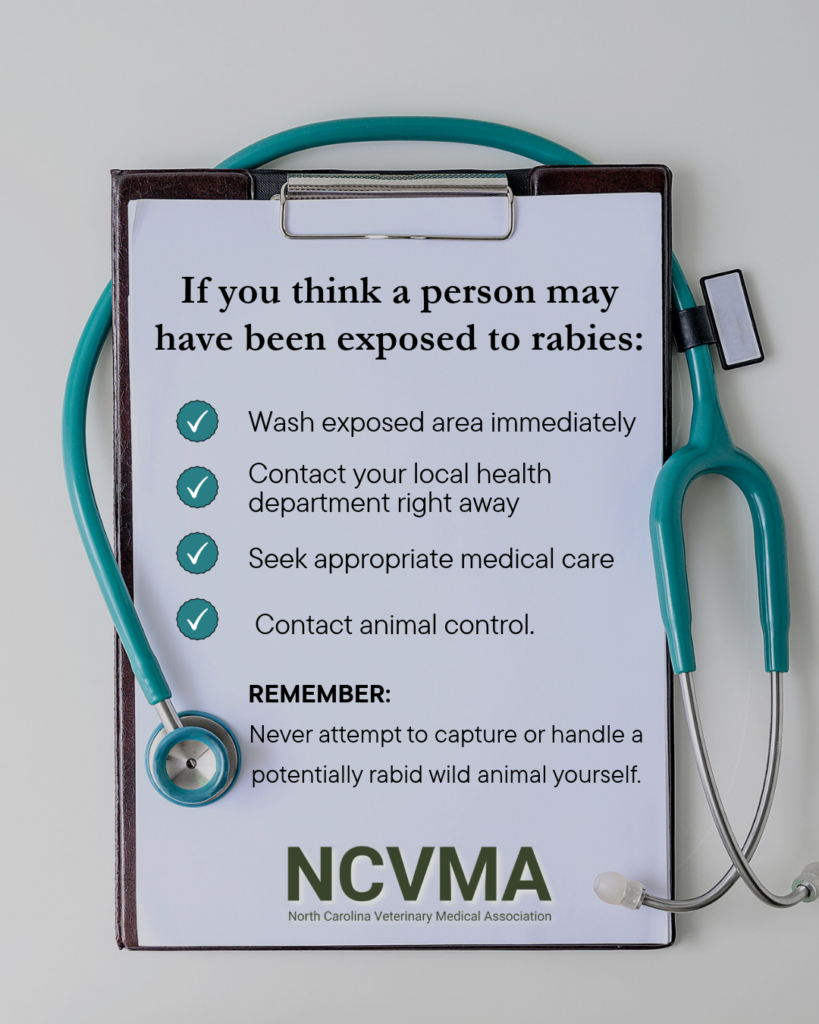
If you think you or another person may have been exposed to rabies, the response is different from managing a pet exposure.
- Wash bites, scratches, and other potentially exposed wounds immediately and thoroughly with soap and water for 15 minutes.
- Contact your local health department promptly. They can assess the rabies risk and help determine whether PEP is needed. In North Carolina, NCDHHS recommends calling the local health department before going to an urgent care or emergency department specifically for rabies PEP guidance.
- Seek appropriate medical care for wound treatment and other bite- or scratch-related concerns.
- Contact animal control. If the animal can be safely captured, confined, or tested by the appropriate professionals, that information may be important to the investigation.
Remember: Never attempt to capture or handle a potentially rabid wild animal yourself.
What Happens to an Animal That Bites a Person?
A common misconception is that if a dog bites someone, the dog will automatically be euthanized and tested for rabies. In North Carolina, that is not how every situation is handled. When a dog, cat, or ferret bites a person, the animal is generally subject to a 10-day confinement and observation period, regardless of its rabies vaccination status. The local health director determines the location and conditions of that confinement.
There is an important reason for this observation period. If a dog, cat, or ferret were capable of transmitting rabies through its saliva at the time of the bite, it would be expected to develop signs of illness during the observation period. An animal that remains healthy throughout the required period provides public health officials with important information when assessing the bite.
Since individual circumstances can differ, owners should report bites as directed and follow instructions from local public health and animal control authorities rather than trying to interpret confinement or testing requirements themselves.
Why We Take Rabies So Seriously, Even Though Human Cases Are Rare
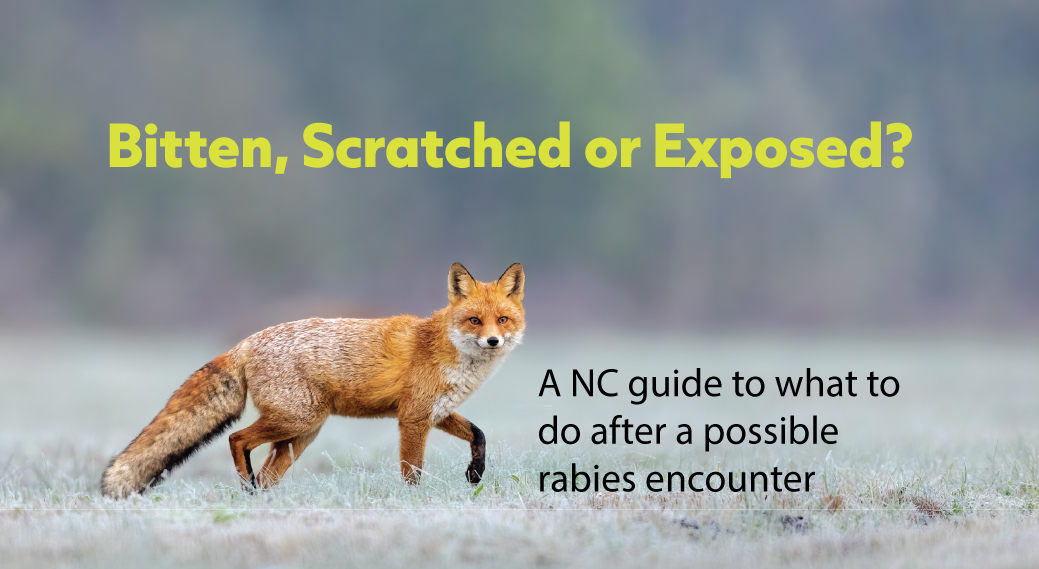
North Carolina is one of the top states in the country for wild animal rabies cases. Raccoons, skunks, foxes and bats are the most common vectors of the disease in North Carolina, but it can be carried by any mammal. Despite modern medical advances, there is still no way to test for the disease without submitting a dead animal for testing, so getting appropriate medical care quickly is imperative.
Also, since there is no way to test for rabies, there is no known titer test, or threshold, to know whether or not your pet’s previous vaccinations are adequate to properly protect them in case of exposure. This is why state law requires them to stay current on the rabies vaccine for everyone’s protection. The vaccine has proven itself safe and effective, with minimal side effects for dogs, cats and ferrets of all ages. People who have livestock should talk to their veterinarian about rabies vaccinations, as cows, horses, goats and other farm animals have tested positive as well.
Animals aren’t the only ones who get rabies shots. Most veterinarians take the step to get vaccinated for rabies early in their careers because our chance of exposure is higher than the average person. Just like animals, we get a booster if we’ve been likely been exposed to a rabid animal.
As veterinarians, we spend our careers preventing diseases we hope our clients and patients never have to experience, and rabies may be one of the clearest examples of why prevention matters. Thanks to animal vaccination, effective human post-exposure treatment, surveillance, and other public health measures, human rabies is now extremely rare in the United States. However, rare does not mean gone.
Recent events here in North Carolina are important reminders that rabies continues to circulate in our communities, even in urban environments. In September 2026, two people attempted to help a struggling bat at Shelley Lake in Raleigh. The bat later died and tested positive for rabies. Just weeks earlier, multiple baby goats associated with a North Carolina mobile petting zoo tested positive for rabies, prompting public health officials to identify and evaluate people who may have had contact with the animals.
These situations involved very different animals and circumstances, but they share an important lesson: rabies is a reality in North Carolina, and an unexpected encounter can quickly require veterinary and public health attention. Rabies is nearly always fatal once symptoms develop, so prevention, education, and prompt action after a potential exposure remain critical.
Vaccinating our pets doesn’t just protect them. It also helps protect the people who love them and the communities we share.
Prevention Starts Long Before the Bite
The best rabies emergency is the one we are prepared for before it happens. Keeping your pets current on their rabies vaccinations, limiting their interactions with wildlife, keeping vaccination records readily available, and knowing who to call can turn an alarming encounter into a situation with a clear plan.
Rabies may be rare in people, but its continued presence in North Carolina animals, and the serious consequences of infection, make prevention and awareness just as important today. So when you finish reading this, take a moment to check your pet’s rabies certificate and make sure their vaccination is current.
A little preparation today can make all the difference when the unexpected happens.